Lendable Inventory Concentration, Recall Risk, and Equity Pricing Anomalies (sole-authored)
I find that the returns of equity pricing anomalies remain large and significant net of fees in stocks whose lendable shares are concentrated among a few lenders. I argue that recall risk explains this pattern. Lenders can recall shares at any time, and when lendable inventory concentration (IC) is high, one withdrawal can recall more shares than borrowers can replace in time. Within firms, a one-standard-deviation higher IC predicts a 2.1 percentage point higher next-month recall event probability (mean 10.9%), controlling for the fee and lendable supply. This recall risk deters short selling even when unlent shares are available. At the highest IC, the same overpricing signal attracts about one quarter as much short interest as at the lowest IC. Less of the overpricing is therefore corrected. Average anomaly returns are 0.43% per month higher in the top IC quintile than in the bottom quintile, mainly through the short leg, and the gap is still 0.33% per month net of fees. Russell 3000 inclusion, which broadens the lender base, lowers recall risk and raises short interest most in overpriced stocks with high pre-inclusion IC.
Key result
Anomaly returns are concentrated in stocks whose lendable inventory is held by a few lenders (high IC). For each stock, NetLeg is the number of anomalies that place it in the long leg minus the number that place it in the short leg. Within each IC group, I sort stocks into NetLeg quintiles and go long Q5 (most underpriced) and short Q1 (most overpriced).
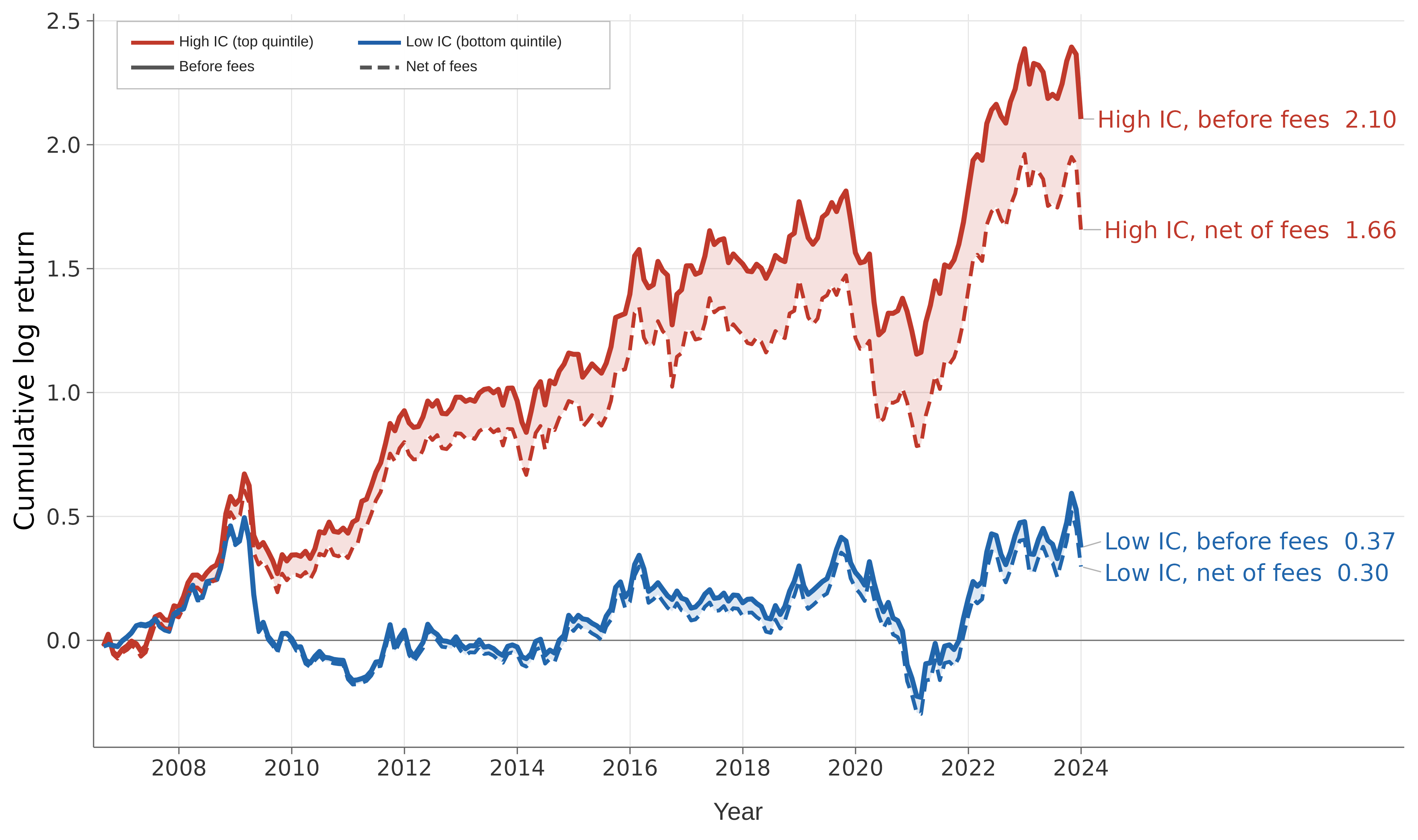
| Bottom IC quintile | Top IC quintile | |
|---|---|---|
| Before fees | 31 (0.8) | 122 (2.7) |
| Net of fees | 27 (0.7) | 100 (2.2) |
| DGTW-adjusted, net of fees | 28 (1.2) | 102 (2.9) |